
By Denis Pilipishin (LinkedIn), independent researcher and analyst with over 20 years of experience in nuclear energy, fuel cycle markets, technology and strategic infrastructure, including consulting work for the World Nuclear Association .
Abstract
This article examines the role of Small Modular Reactors (SMRs) in supporting coal phase-out, strengthening system resilience, and advancing technological capabilities, with a primary focus on Romania as the most advanced SMR project in Central and Eastern Europe (CEE). Unlike traditional large-scale nuclear plants, SMRs rely on standardized designs, factory-based production, and modular deployment, potentially reducing capital costs and enabling more flexible capacity additions. However, significant challenges remain, including high first-of-a-kind costs, evolving licensing frameworks, and the uneven development of supply chains.
Using Romania as a case study, the article analyses how the country leverages international partnerships, innovative financing mechanisms, and coal-to-nuclear transition strategies at the former Doicești coal plant site to position itself at the forefront of SMR deployment in Europe. In contrast to slower progress in most other CEE countries, Romania’s project has reached several key milestones, including the Final Investment Decision taken in 2026, moving it into the implementation preparation stage and strengthening Romania’s position as the regional frontrunner.
The article argues that, in the Romanian case, SMRs should be understood not as the main source of decarbonisation or energy independence, but as a strategic complement to large-scale nuclear power: a tool for replacing coal capacity, improving system flexibility in a more renewables-based electricity mix, developing industrial capabilities, and testing the practical viability of the SMR model under European conditions. It concludes that the Romanian project is best seen as a regional stress test: if it demonstrates financial viability, regulatory progress, and the potential for standardisation and repeatability, it could catalyse wider SMR deployment across Central and Eastern Europe after 2030.
1. Introduction
Interest in sustainable low-carbon energy sources in Central and Eastern Europe has increased significantly in recent years. The main reasons include the following:
- CEE countries remain highly vulnerable in terms of fossil fuel supplies. The consequences of the 2022-2023 energy crisis had not yet been fully overcome when the armed conflict in the Persian Gulf that began in 2026 once again triggered a sharp rise in energy prices and a new wave of concern over security of supply.
- The EU has set the goal of achieving climate neutrality by 2050.
- The phase-out of coal-fired capacity remains a priority task (coal phase-out).
One promising solution is nuclear energy, whose development can proceed alongside the deployment of renewable energy sources. CO₂ emissions from nuclear power are very low. On a lifecycle basis, they are 15 times lower than those of electricity generation from natural gas, 30 times lower than those of coal-fired generation, and comparable to emissions from wind and hydropower[1]. At the same time, nuclear power units can provide baseload electricity around the clock, independently of weather conditions and seasonal fluctuations, and can operate with capacity factors of 80-90%[2]. However, the construction of large units (1000+ MW) requires major investment and long lead times. During implementation, both project budgets and commissioning schedules may increase substantially, in some cases several-fold. The most striking examples are Olkiluoto-3 in Finland and Vogtle in the United States.
Small modular reactors (SMRs) may become an attractive alternative, offering not only lower capital costs and shorter construction times, but also greater flexibility in site selection and, depending on reactor type, additional applications such as district heating, industrial heat generation, or hydrogen production. However, these advantages remain largely theoretical, and their practical feasibility still has to be demonstrated.
In March 2026, the Strategy for the development and deployment of Small Modular Reactors (SMRs) in Europe was adopted, noting that SMRs are becoming one of Europe’s “major industrial development projects”. According to this document, “SMR capacity in the European Union by 2050 range from 17 GW to 53 GW for electricity generation and other purposes (heat, hydrogen, synthetic fuels)”[3]. Given that EU countries currently have a combined 96 GW of nuclear generating capacity[4], these figures appear significant, especially the upper one.
At present, the situation with SMR development across CEE countries is uneven. No SMR has yet entered operation, but Romania and Poland occupy leading positions in the region. This article focuses on Romania, as this case combines several particularly important factors, including state support, international partnership, blended financing mechanisms, and site selection within a coal-to-nuclear logic. Moreover, the Final Investment Decision taken in February 2026 on the Romanian Doicești project[5] moved it into the preparation-for-implementation phase (Pre-EPC stage) and made the country the regional leader in SMR development.
It would not be an exaggeration to say that the outcome of this project will have a serious impact at least at the regional level. The Doicești project will serve as a litmus test for the entire SMR concept in CEE: its success or implementation difficulties will show how real the promised advantages of small modular reactors are in Central and Eastern Europe. This is precisely why the Romanian Doicești case deserves close analysis.
2. What are SMRs?
To understand the place and role of this specific case study against the global background, we need to clarify briefly what is meant by small modular reactors and what main types they include.
2.1. Definition and main advantages of SMRs
According to the IAEA definition, SMRs “are defined as advanced reactors that produce electricity of up to 300 MW(e) per module”[6]. However, size is not the only issue. There are exceptions even in terms of output, for example the British Rolls-Royce SMR (470 MWe) and the French NUWARD platform (up to 400 MWe), whose electrical output clearly exceeds this threshold and is comparable to that of the old Soviet VVER-440 unit. Yet the real value of the SMR concept lies not so much in reducing the capacity of a single reactor unit as in changing the very paradigm of nuclear construction and financing. For the purposes of this study, much greater importance should be attached to such SMR features as:
-
-
- modularity;
- scalability;
- factory fabrication;
- lower upfront capital.
-
Modularity allows a plant to be assembled from ready-made units, while scalability makes it possible to add capacity step by step as demand grows and financing becomes available. Factory fabrication shifts most work from the site to controlled industrial production. In theory, this should substantially reduce the amount of upfront capital required and shorten construction times compared with traditional large units.
At the same time, these advantages are fully realised only under conditions of serial production. A first-of-a-kind project (FOAK) almost always faces the opposite effect: the absence of established supply chains, the need to pass through the full licensing cycle, and the lack of a learning effect lead to a situation in which the specific costs per kilowatt of installed capacity in FOAK projects are noticeably higher than in later serial units.
For the full realisation of SMR potential, reform of the regulatory sphere is also important. Nuclear energy traditionally relies on site-specific licensing, meaning that a licence is issued for a specific unit at a specific site. For serial SMR deployment, it would be useful to borrow certain elements from the regulatory model of the aviation sector. In aviation, the regulator issues a type certificate for an aircraft design once, and subsequent serial aircraft of that type are allowed to operate with far fewer additional checks. A similar approach could significantly reduce both costs and construction times in the serial factory fabrication of modules[7]. At the same time, nuclear-specific factors such as radiation safety, long-term waste management, and site-related risks do not allow the aviation approach to be copied in full. Therefore, the issue is rather the adaptation of selected elements, such as design certification, factory approval, and mutual recognition between regulators.
2.2. Types of SMRs
The format of this article does not allow for a detailed review of SMR types, but a brief overview is necessary because it helps to assess Romania’s position against the wider global context. Estimates of the number of SMR projects worldwide differ. While the OECD speaks of 127 projects, of which 28 are currently not under active development[8], the IAEA identifies only 68 projects. It is important to note that only 22 of them use the “traditional” water-cooled technology (WCR), while the remaining 46 comprise 14 gas-cooled reactors (HTGR), 11 molten salt reactors (MSR), 10 liquid-metal fast neutron reactors (LMFR), and 11 microreactors[9]. Reactors of the MSR, HTGR, and LMFR types, as well as some other advanced types, are usually classified as Gen IV.
One important practical implication of reactor-type choice is the coolant outlet temperature. Water-cooled SMRs normally operate at about 300-320 °C. This is sufficient for efficient electricity generation and low-temperature heat applications such as district heating, seawater desalination, and steam for light industry. High-temperature reactors, such as MSRs and HTGRs, provide 700-950 °C and open access to hard-to-abate industrial processes, including hydrogen production, synthetic fuels, steel, cement, and chemicals, where fossil fuels still dominate[10]. This possibility of clean heat production is extremely important because in industry less than 40% of energy is consumed in the form of electricity, while the overall average share of electricity in total energy consumption is even lower, at 21%[11]. These figures mean that carbon-free electricity generation alone cannot in principle solve the global decarbonisation problem, because most of the energy used by humanity is still consumed in non-electric form. Here high-temperature SMRs can make a significant contribution to the decarbonisation of energy-intensive industries.
However, “traditional” reactors have an advantage of a different kind. Water-cooled SMRs, or light-water reactors, are the most technologically mature and the most advanced in regulatory terms among all SMR classes. Because they rely on evolutionary designs derived from proven Gen III/III+ large reactors, with certified solutions already available, they can be deployed faster than high-temperature Gen IV systems, which still require full licensing, fuel qualification, and materials validation.
Romania chose the water-cooled NuScale design, thereby giving priority to technological maturity and faster deployment, even at the cost of limiting the possibilities of high-temperature cogeneration for energy-intensive industrial processes.
3. Romania: energy context and strategic logic of the project
3.1. Romania’s generation mix and nuclear development
Romania’s generation mix is quite diversified and includes most of the main forms of electricity generation [12]. The shares of different sources are shown in the chart below [13].
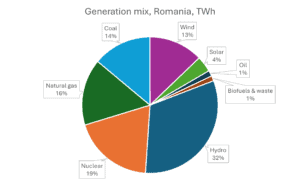 In the context of this article, two points are particularly noteworthy. The share of nuclear generation in Romania is 19%[14], and according to some other sources it is slightly higher. This is a significant figure compared with the world average of 9%, and also a solid result compared with other countries, where the share ranges from a few percent to more than half of total output[15].
The share of coal generation is 14%[16], which is noticeably lower than in some other CEE countries. For example, in Poland the share of coal generation reaches 56%[17], in the Czech Republic 36%[18], and in Germany 24%[19] (the figures may vary across sources). Therefore, although the coal-to-nuclear transition is in principle a complex technical, economic, and socio-political task, in the Romanian case it looks much more realistic than in some other countries of Central and Eastern Europe.
Romania’s nuclear generation is represented by two CANDU-6 units at the Cernavodă NPP on the Danube River, whose construction began in 1983. This choice can be regarded as unusual both by the standards of the socialist bloc and globally. In socialist countries, reactors of Soviet design, mainly VVER-440s, were generally built, but Romania was able to choose a Western technology, namely the Canadian CANDU. According to the World Nuclear Association (WNA), the dominant share of the global reactor fleet, more than 85% if measured by the number of reactor units, consists of so-called light-water reactors, either pressurised water reactors (more than 71%) or boiling water reactors (almost 14%)[20]. The CANDU reactor differs significantly from light-water reactors both in design and in its fuel cycle. A very important point is that it does not require uranium enrichment and uses natural uranium oxide fuel with a U-235 content of 0.7%; however, it requires a more effective moderator, namely heavy water (D2O).
The first two CANDU units in Romania were commissioned in 1996 and 2007. At the same time, work continues on the completion of Units 3 and 4 at Cernavodă (also CANDU 6), which are planned to enter commercial operation in 2030 and 2031 respectively[21].
Thus, unlike some CEE countries such as Estonia and Lithuania, where the historical and systemic context has led to a primary focus on SMRs, Romania continues to develop large-scale nuclear power as well. Small modular reactors in Doicești therefore appear not as an alternative, but as a complement to the traditional nuclear programme.
The development of nuclear power in Romania is regarded as one of the key pillars of decarbonisation and energy independence. Until the early 2030s, the main contribution to these goals will come from large reactor units, but the SMR track has its own specific advantages, allowing it to address tasks for which large units are less suitable.
3.2. How are SMRs useful for Romania?
The main specific advantages of SMRs for Romania are as follows:
- Direct replacement of coal-fired capacity at brownfield sites (coal-to-nuclear). Doicești is a former coal-fired power plant site (about 600 MW of coal-fired capacity is being replaced by 462 MW of clean capacity). This makes it possible to use existing infrastructure (grid connections, land, access roads), minimise social costs (jobs in a coal region), and accelerate the just transition, understood as a process in which coal phase-out is accompanied by worker retraining, preservation of employment in the region, and measures to diversify the local economy[22] [23]).
- Flexibility and complementarity with renewables. Generation from renewable sources (solar and wind) depends strongly on weather, time of day, and season, which creates a balancing problem for the power system. Large nuclear units traditionally operate in baseload mode and are poorly suited to frequent load-following. SMRs are designed from the outset for operation in grids with a high share of renewables and therefore have built-in flexibility tools (discussed in more detail below).
- A smaller initial scale and lower investment threshold compared with large reactor units. This reduces financial risks and makes it possible to expand capacity step by step.
- Development of new competences and local supply chains. The project gives Romania experience with modern modular light-water technology, different from CANDU technology, and stimulates local industry and the development of skilled personnel.
- Political, symbolic, and demonstration value. The first European commercial SMR project (after the FID in February 2026) positions Romania as a leader in CEE, and will reinforce this leadership if the subsequent stages of implementation proceed successfully.
4. NuScale Power ModuleTM (NPM)
The Romanian Doicești project is based on the NuScale Power ModuleTM technology, the first and so far the only small modular reactor to receive standard design approval from the U.S. Nuclear Regulatory Commission (NRC)[24]. According to the developer [25], the design builds on proven integral pressurised water reactor technology and represents the result of 17 years of development costing around USD 1.6 billion.
Each NPM module has an electrical output of 77 MWe (gross), a thermal output of 250 MWt, and a capacity factor of more than 95%. The module is a cylindrical steel vessel 4.6 m in diameter and 23.2 m high, containing the reactor, steam generators, and the main primary-circuit equipment. The total mass of one module is about 700 tonnes; it is delivered to the site in three factory-fabricated segments by road, rail, or water transport. The fuel is standard for light-water reactors (UO₂, 17×17 configuration, enrichment below 4.95%), and the fuel cycle length is up to 18-21 months [26].
NuScale’s key advantage is generally considered to be its high level of passive safety[27]. The reactor is designed according to the “walk-away safe” principle: in the event of loss of power or absence of an operator, it shuts down automatically and provides unlimited passive cooling without any additional supply of water or electricity. Three main safety systems, the decay heat removal system (DHRS), the emergency core cooling system (ECCS), and the steel containment, are complemented by a large underground pool of water, which serves as the ultimate heat sink and can absorb the residual heat of all modules for more than 30 days. The modules are located below ground level in a Seismic Category I building, which increases resilience to external impacts, including aircraft impact, extreme weather conditions, and electromagnetic pulses.
The reactor was designed from the outset for operation in grids with a high share of renewables. Its flexibility is provided by three main mechanisms (NuFollow™)[28]:
- switching individual modules off and on, for long-term changes;
- power regulation using central control rods, in the approximate range of 20-100%;
- 100% steam turbine bypass, the fastest method, allowing electrical output to be reduced to 20% in about 8 minutes by directing steam straight to the condenser.
From the point of view of economics and deployment, modularity and factory fabrication are particularly important. The standard VOYGR-6 configuration includes six modules with a total capacity of 462 MWe and, according to the developer, can be implemented within an indicative construction period of 36 months thanks to the wide use of serial components. The possibility of phased deployment allows generation to begin already from the first unit, reducing the financial risks of FOAK projects and providing flexibility for growing demand or coal-capacity replacement. Configurations with 4 and 12 modules also exist. The latter can generate up to 924 MWe. Another noteworthy company statement is the following: “Following a catastrophic loss of infrastructure, a 12-module plant can power a mission critical facility micro-grid at 154 MWe for 12 years without new fuel”[29].
5. Romania: Doicești project history
The partnership between the United States and Romania on SMRs dates back to March 2019, when the state-owned nuclear power company Nuclearelectrica and NuScale signed a memorandum of understanding to explore potential development opportunities[30]. It gained clear political and commercial momentum in November 2021, when the two parties concluded a teaming agreement at COP26 to advance what was presented as the first SMR deployment in Europe [31]. In May 2022, Doicești was confirmed as the preferred site for a six-module NuScale project, and in September 2022 Nuclearelectrica and Nova Power & Gas established RoPower Nuclear as the dedicated project company[32]. The Doicești site itself was selected after a USTDA[33]-backed site-screening process and is a classic coal-to-nuclear repurposing location.
Project preparation then moved through a recognisable sequence of pre-construction milestones. FEED Phase 1 started in late 2022 and continued into 2023; in parallel, the project developed its Licensing Basis Document (LBD). In August 2023, Romania’s nuclear regulator CNCAN approved the LBD as compliant with national regulatory requirements. In April 2024, an IAEA SEED follow-up mission concluded that the process used to select the Doicești site was in line with international safety standards. In July 2024, RoPower and Fluor signed the FEED 2 contract[34]. Finally, on 12 February 2026, Nuclearelectrica shareholders approved the Final Investment Decision, moving the project into what the company calls the third stage of development.
5.1 Regulatory process
Romania’s regulatory pathway is one of the most structured SMR licensing tracks in Europe so far. Three elements stand out. First, the approval of the Licensing Basis Document (LBD) by CNCAN in 2023 established an early licensing bridge between the NuScale design basis and Romanian rules[35]. Second, the project underwent external IAEA review through the SEED process, which strengthens the credibility of site selection. Third, Nuclearelectrica’s own planning documents show that the project is being advanced through phased engineering and authorisation gates: the LNTP/preliminary works phase is intended to complete engineering and safety documentation, obtain the CNCAN nuclear safety building permit, seek European Commission state-aid clearance, and structure financing before the FNTP/construction phase proceeds. This is a more formalised roadmap than exists for most European SMR proposals.
5.2 Financing structure
The financing model is still not fully closed, and this should be stated plainly. The project’s SPV is RoPower Nuclear, owned equally by Nuclearelectrica and Nova Power & Gas. The project has benefited from staged financial support for development work: Nuclearelectrica’s public filings show approval for negotiations on an approximately USD 98 million EXIM facility tied to FEED 2 contracts, and Romanian and U.S. public statements have repeatedly referred to up to USD 3 billion of potential support from U.S. EXIM plus USD 1 billion from the U.S. International Development Finance Corporation. At the same time, Reuters reported in February 2026 that Romania still needed time to devise the overall funding plan for what had become a very large capital project.
This combination is analytically significant. Romania has moved further than most peers in project definition, but it has not yet fully solved the classic SMR challenge of assembling a robust FOAK financing structure. The financing picture therefore appears layered: equity through the Romanian project company, development-stage debt support, potential large-scale U.S. public finance participation, and likely some additional private or institutional participation if the project maintains momentum. Reuters also reported earlier investor interest in project equity, which supports this interpretation, although no full final financing package has yet been publicly presented.
5.3 Government support and international partners
Doicești is not just a corporate project; it is a state-backed strategic project. Nuclearelectrica’s February 2026 announcement explicitly framed the FID as conditional on a “solid framework of support and cooperation” among authorities and partners. The international partner base is unusually broad for a European SMR project: NuScale provides the reactor technology; Fluor is central to FEED/EPCM development; Nova Power & Gas / E-INFRA anchors the private Romanian side; and earlier project announcements also linked in Samsung C&T and Sargent & Lundy alongside Romanian and U.S. public institutions. This breadth is one reason Doicești is often treated as Europe’s lead SMR demonstration case.
5.4 Estimated costs
The most recent public cost indication is Reuters’ February 2026 report citing Romanian Prime Minister Ilie Bolojan, who said the planned 462 MW plant would cost USD 6-7 billion[36]. That is materially higher than some earlier and more optimistic narratives about SMR affordability and underlines a core policy point: even for a leading project, FOAK SMRs remain capital-intensive. It also means that Doicești should be analysed not as a “cheap small nuclear” project, but as a strategically staged nuclear megaproject in modular form.
5.5 Deployment timeline
Following the Final Investment Decision of 12 February 2026, RoPower Nuclear has defined a preliminary deployment timeline. The company has set July 2033 as the target commercial operation date for the first 77 MWe NuScale module, with the full six-module, 462 MWe plant scheduled for December 2034, subject to the performance of the FOAK unit and final financing closure. This staggered approach is explicitly designed to de-risk the project by limiting initial capital exposure to a single module[37].
5.6 Expected economic impact
Romania has published clearer local-development messaging than many other European SMR candidates. Nuclearelectrica says Doicești will replace 600 MW at the former thermal power plant with 462 MW of clean power and generate about 4,000 jobs during the broader development cycle: roughly 200 permanent jobs, 1,500 construction jobs, and 2,300 jobs in component production and assembly[38]. The company also emphasises the development of a related industrial base and the attraction of associated investment. Reuters has separately noted that the wider Doicești concept includes an 80 MW solar park already installed on site, reinforcing the idea that this is a broader clean-energy redevelopment platform rather than a stand-alone reactor island[39].
5.7 Analytical assessment
Doicești’s biggest strength is that it has moved beyond generic ambition into a real project sequence: site selection, licensing-basis approval, IAEA site review, FEED 2, and now FID. Its second strength is strategic symbolism: it is the clearest coal-to-nuclear repurposing case in Europe. Its main unresolved challenge is financial: the project now has to convert political support and U.S.-backed development finance into a complete execution-ready funding structure for a plant that could cost up to USD 7 billion. In short, Romania leads Europe in project maturity, but it still has to prove bankability at scale.
6. Economic viability of the project: what exactly Doicești must prove
The most difficult question in the discussions of small modular reactors concerns not so much the technology itself as the economics of their deployment. In public discourse, SMRs are often presented as a more affordable and flexible alternative to large nuclear power units. As noted at the beginning of this article, their main advantages are modularity, serial factory fabrication, and the possibility of phased deployment. According to the developers’ concept, these features should reduce upfront capital costs and shorten timelines. However, these advantages are fully realised only when the transition is made from isolated demonstration projects to serial production.
This is precisely why the Romanian Doicești project should be seen above all not as proof that “small nuclear is cheaper than large nuclear”, but as Europe’s most advanced test of whether an SMR project can become financially and organisationally viable under real European conditions.
The project’s financial model remains open: it relies on a combination of Romanian corporate participation, state support, and potential American financial instruments, but no full final financing package has been publicly presented. The classic FOAK problem of forming a stable capital structure therefore remains.
Capital-cost estimates are especially revealing. As noted above, in February 2026 Romanian Prime Minister Ilie Bolojan stated that the Doicești project as a whole was estimated at USD 6-7 billion. Based on a total capacity of 462 MW, this amounts to roughly USD 13,000-15,000 per kW of installed capacity [40] (overnight capital cost).
For comparison, specific construction costs for large nuclear power units worldwide usually lie in the range from USD 7,000 to more than USD 15,000 per kW, including overruns [41]. Thus, the Romanian FOAK project is closer to the upper end of this range, at a level shaped in part by the experience of constructing Units 3 and 4 of the Vogtle NPP in the United States, where major delays and cost overruns became a well-known example[42].
In this context, the experience of the first U.S. project based on the same NuScale technology is especially instructive: the Carbon Free Power Project (Utah Associated Municipal Power Systems, UAMPS) near Idaho Falls[43]. This FOAK project, similar in configuration (six modules, 462 MW), faced a sharp rise in costs: by 2023 the total cost had exceeded USD 9.3 billion, or about USD 20,000 per kW, while the projected levelised cost of electricity (LCOE) had risen to USD 89/MWh[44]. The project was cancelled in November 2023 because the participants, a group of municipal utilities, failed to secure the required volume of power subscriptions under conditions of market-based pricing and high FOAK risk.
Unlike the UAMPS consortium of small municipal utilities, which relied primarily on market-based mechanisms and long-term subscription agreements with participating utilities, Nuclearelectrica acts as a state-owned company operating within the EU’s strategic framework. Here decarbonisation, coal phase-out, and energy-security goals make it possible to use a different model of risk allocation, not a purely merchant one, but rather blended finance with strong state and international support.
At similar capacity and with the same NuScale technology, the public cost estimate of the Romanian project remains high for a FOAK project, but noticeably lower than that of the cancelled UAMPS project at the peak of its cost escalation. The key factor is the broader political and strategic framework: direct replacement of coal capacity at a brownfield site, contribution to regional energy security, acceleration of the just transition, and development of a local industrial base. This combination of state, corporate, and international levers, namely Nuclearelectrica as the state-controlled anchor investor, Nova Power & Gas as the private Romanian partner, the United States through EXIM/DFC, and the technological partnership with NuScale and Fluor, significantly increases the probability of bringing the project to the construction stage compared with a purely commercial model in the United States.
To confirm its economic viability, the project must prove several interconnected assumptions at once: that the announced financial structure can be completed in fully executable form; that timelines and cost parameters can be kept under control under European conditions; that a real, rather than merely institutional, local and transnational supply chain can be formed; and that the project can move from a single FOAK facility to standardisation and repeatability. In this sense, Doicești is not the final proof of SMR maturity, but the most important European test of that maturity so far.
7. Significance of the Doicești project for energy security and greenhouse-gas emission reduction in Romania
Although small modular reactors are traditionally presented as an instrument for simultaneously addressing decarbonisation and energy independence, in the Romanian context their role is more specific and complementary.
Romania already has one of the most developed nuclear programmes in Central and Eastern Europe. Two operating CANDU-6 units at the Cernavodă NPP provide about 19-20% of national electricity generation. After the commissioning of Units 3 and 4, planned for 2030 and 2031, the total installed capacity of large-unit nuclear generation will exceed 2,600 MW.
Against this background, the contribution of the Doicești project looks modest. The first NuScale module, planned for commissioning around 2033 (77 MW), will account for less than 3% of the country’s total nuclear capacity. The full commissioning of all six modules (462 MW) in the following years will raise this share only to 15-17%. Thus, over the next 10-15 years, the main contribution to power-sector decarbonisation and the provision of stable baseload generation will still come from large-scale nuclear power.
The strategic value of SMRs for Romania lies in other dimensions:
- direct replacement of coal-fired capacity at brownfield sites within a coal-to-nuclear logic, with preservation of jobs and minimisation of the social costs of transition;
- greater flexibility of the power system and more effective balancing of the growing share of variable renewable energy sources;
- the development of new industrial competences, localisation of production, and skilled personnel in the field of modern modular nuclear technology;
- a demonstration effect that strengthens Romania’s position as a regional leader in SMR development.
The argument of energy independence, which is also often linked to SMR development, deserves separate consideration. In my view, an objective perspective on the issue is needed here. Full energy autonomy is possible only when a country controls the entire chain, from reactor design and manufacturing to nuclear fuel production, that is, the entire front end of the nuclear fuel cycle: natural uranium mining, conversion to UF6, uranium enrichment, and fuel fabrication. In reality, however, such examples are rare. Therefore, in a stricter sense, the issue is not the elimination of external dependence, but its transformation.
In this respect, nuclear energy does indeed have several advantages. The share of nuclear fuel in the cost of generated electricity is comparatively low. Nuclear power is not sensitive to short-term market price fluctuations, even when they are significant, or to supply disruptions. Moreover, unlike natural gas, nuclear fuel can be stockpiled several years ahead and stored directly on site.
Nevertheless, even if an SMR fleet is created, Romania does not leave the system of external dependencies, but moves to a different configuration of them. Dependence on fossil-fuel supplies is replaced by dependence on technological solutions, financial mechanisms, licensing regimes, and international supply chains associated with the nuclear sector.
In this context, energy security is more accurately understood not as the achievement of full independence, but as a transition to a more stable and manageable model of dependence, with greater predictability, the possibility of long-term planning, and lower sensitivity to short-term shocks. The Doicești SMR project should also be understood in this sense.
8. Romania in the wider European and Central and Eastern European context
In a broader regional context, the significance of the Romanian case goes far beyond national energy policy. Several countries in Central and Eastern Europe show interest in SMRs, but in most cases this interest is still limited to early-stage work, feasibility studies, or political declarations. Romania stands out because it has advanced much further than the others in institutional, site-related, and project-financial terms.
A special place belongs to Poland, the only country in the region that can challenge Romania for regional leadership. Unlike the Romanian approach, Poland is implementing the most ambitious fleet model: the Orlen Synthos Green Energy (OSGE) programme, based on the GE Vernova Hitachi BWRX-300, envisages up to 24 modules across six sites. The emphasis is on design standardisation, localisation of supply chains, and industrial application, including heat supply and energy provision for energy-intensive consumers. The signing of the Poland Generic Design Agreement in February 2026 significantly strengthens the potential for serial deployment and lower specific costs in later units.
At the same time, Romania retains clear leadership in terms of the maturity of an individual project. The Final Investment Decision (FID) on Doicești in February 2026 moved the Romanian case into the preparation-for-implementation phase (pre-EPC). This makes Doicești the most advanced named SMR project in Europe, the first to pass the point of no return at shareholder level and to demonstrate the practical implementation of the coal-to-nuclear model.
Thus, the two leading approaches in CEE complement each other: Romania acts as the pioneer and testing ground for a single commercial project, while Poland lays the foundation for potential serial and industrialised deployment of the technology in the region.
In the other countries of Central and Eastern Europe, the following projects can be noted. In the Czech Republic, ČEZ is implementing a partnership with Rolls-Royce SMR and carrying out preparatory work at the Temelín site. Estonia has made progress in establishing the regulatory framework and searching for a site for the construction of a BWRX-300 unit. Slovakia has conducted studies under Project Phoenix, examining four possible sites for SMR construction, and states that the country has high potential for development in this field. At the same time, it is developing a joint project with Newcleo on lead-cooled fast reactors. Lithuania, Bulgaria, and Hungary remain at the stage of techno-economic assessments, memoranda, and pre-project studies. Thus, most initiatives in the region are still at an early stage of development.
9. Conclusion
The Romanian Doicești project is important not because it has already proven the economic superiority of small modular reactors, and not because it will become the main source of decarbonisation and energy resilience in Romania. On the contrary, the analysis presented here shows that in the foreseeable future the main burden in both areas will continue to be borne by the country’s conventional nuclear sector, namely the two operating and two under-construction CANDU units. Doicești should therefore be seen not as an alternative to large-scale nuclear power, but as its strategic complement: an instrument for replacing coal generation, operating in grids with a high share of renewables, increasing power-system flexibility, developing new industrial competences, and testing the model of a just transition in a coal region.
This is where the broader significance of the Romanian case for Central and Eastern Europe lies. Doicești has become the most advanced SMR project in Europe not so much because of the technology used, but because of a combination of factors that is rare for the region: political will, regulatory preparation, international partnership, blended financing mechanisms, and a clear coal-to-nuclear logic. As a result, Romania is the first country in the region to move the discussion of SMRs from the realm of technological expectations to that of real project implementation.
The main question that Doicești must answer concerns the ability of European institutions to make such a project manageable and reproducible. The project must demonstrate that SMRs can be financed, licensed, and implemented under European conditions without a critical loss of control over costs, timelines, and supply chains. In other words, the issue being tested is not whether SMRs are cheaper, but a much more important proposition: whether modular nuclear energy can move from a FOAK project, relying on strong state and international support, to a model suitable for repetition and scaling. Without such a transition from the logic of a unique facility to the logic of a partially standardisable product, the European SMR agenda risks remaining a set of isolated demonstration cases.
Doicești should therefore be regarded as the first European stress test of the entire SMR agenda. For Romania, the success of the project would mean not only stronger national energy resilience, but also a reinforced position as a technological and industrial leader in CEE. For Europe, it would mean the emergence of the first convincing precedent showing that SMRs can become not merely a subject of political interest, but a practical instrument of decarbonisation, industrial modernisation, and a manageable post-coal transition. Failure, by contrast, would signal that a critical gap still remains between an attractive concept and a scalable reality. In this sense, Doicești is not simply a Romanian energy project, but a test of Europe’s ability to turn SMRs from a promise into industrial and institutional practice.
10. References
- WNA Report. Comparison of Lifecycle Greenhouse Gas Emissions of Various Electricity Generation Sources. https://world-nuclear.org/images/articles/comparison_of_lifecycle1.pdf ↑
- Sfen in English. Nuclear by the Numbers. https://sfeninenglish.org/global-nuclear-production-record-2024/#:~:text=Other%20factors%20that%20contributed%20to%20the%20record,every%20year%2C%20and%20by%20ever%20greater%20amounts. ↑
- European Commission. Strategy for the development and deployment of Small Modular Reactors (SMRs) in Europe. https://eur-lex.europa.eu/legal-content/EN/TXT/?uri=CELEX%3A52026DC0117&qid=1773310096275 ↑
- WNA. Nuclear Power in the European Union. https://world-nuclear.org/information-library/country-profiles/others/european-union ↑
- Nuclearelectrica. The Doicești Small Modular Reactors (SMR) project obtains the Final Investment Decision and enters the third stage of development. https://nuclearelectrica.ro/snn/en/2026/02/12/the-doicesti-small-modular-reactors-smr-project-obtains-the-final-investment-decision-and-enters-the-third-stage-of-development/ ↑
- IAEA. Small modular reactors. https://www.iaea.org/topics/small-modular-reactors ↑
- JAEA-Review. A Proposed Regulatory Framework for Small Modular Reactors. https://jopss.jaea.go.jp/pdfdata/JAEA-Review-2024-018.pdf ↑
- Nuclear Energy Agency. The NEA Small Modular Reactor Dashboard: Third Edition. https://www.oecd-nea.org/jcms/pl_108326/the-nea-small-modular-reactor-dashboard-third-edition?details=true ↑
- IAEA. Small Modular Reactors: Advances in SMR Developments. https://www-pub.iaea.org/MTCD/Publications/PDF/p15790-PUB9062_web.pdf ↑
- UNECE. Technology Brief. Nuclear Power. https://unece.org/sites/default/files/2021-08/Nuclear%20brief_EN.pdf ↑
- EMBER. Chapter 3: Global Electricity Trends. https://ember-energy.org/latest-insights/global-electricity-review-2024/global-electricity-trends/ ↑
- WNA. Nuclear Power in Romania. https://world-nuclear.org/information-library/country-profiles/countries-o-s/romania ↑
- Note: Data on generation shares may vary across different sources. For consistency and comparability within this section, all generation-mix figures are taken from the World Nuclear Association (WNA). ↑
- WNA. Nuclear Power in Romania. https://world-nuclear.org/information-library/country-profiles/countries-o-s/romania ↑
- IAER. PRIS (Power Reactor Information System). https://pris.iaea.org/pris/worldstatistics/nuclearshareofelectricitygeneration.aspx#:~:text=This%20page%20will%20guide%20you%20through%20the,contains%20information%20on%20operating%20experience%20of%20nuclear ↑
- WNA. Nuclear Power in Romania. https://world-nuclear.org/information-library/country-profiles/countries-o-s/romania ↑
- WNA. Nuclear Power in Poland. https://world-nuclear.org/information-library/country-profiles/countries-o-s/poland ↑
- WNA. Nuclear Power in Czech Republic. https://world-nuclear.org/information-library/country-profiles/countries-a-f/czech-republic ↑
- WNA. Nuclear Power in Germany. https://world-nuclear.org/information-library/country-profiles/countries-g-n/germany ↑
- WNA. Nuclear Power Reactors. https://world-nuclear.org/information-library/nuclear-power-reactors/overview/nuclear-power-reactors ↑
- Nuclearelectrica. Investment Projects. Reactors 3 and 4. https://nuclearelectrica.ro/snn/en/investment-projects/reactors-3-and-4/ ↑
- European Commission. Just Transition Platform. https://ec.europa.eu/regional_policy/funding/just-transition-fund/just-transition-platform_en ↑
- European Commission. EU coal regions in transition. https://energy.ec.europa.eu/topics/clean-energy-transition-initiatives/eu-coal-regions-transition_en ↑
- United States Nuclear Regulatory Commission. NuScale US460 Standard Design Approval Documents. https://www.nrc.gov/reactors/new-reactors/advanced/who-were-working-with/applicant-projects/nuscale-us460/documents ↑
- NuScale Power. NuScale Power Module. https://www.nuscalepower.com/products/nuscale-power-module ↑
- NuScale Power. The Nuscale Power Module™ Technical Specifications. https://www.nuscalepower.com/hubfs/NPM-technical-specifications.pdf?hsLang=en ↑
- Frontiers Energy Research. Unique safety features and licensing requirements of the NuScale small modular reactor. https://www.osti.gov/servlets/purl/2418355 ↑
- NuScale Power. NuScale Small Modular Reactor Integration for Hydrogen and Ammonia Production. https://www.nuscalepower.com/hubfs/Website/Files/Technical%20Publications/nuscale-small-modular-reactor-integration-for-hydrogen-and-ammonia-production.pdf ↑
- NuScale Power. NuScale Power Module. https://www.nuscalepower.com/products/nuscale-power-module ↑
- WNN. Final Investment Decision taken for Romanian SMR project. https://www.world-nuclear-news.org/articles/final-investment-decision-taken-for-romanias-smrs ↑
- Nuclearelectrica. NuScale and Nuclearelectrica Reach Agreement at COP26 to Initiate the Deployment of the First Small Modular Reactor in Europe. https://nuclearelectrica.ro/snn/en/2021/11/04/nuscale-and-nuclearelectrica-reach-agreement-at-cop26-to-initiate-the-deployment-of-the-first-small-modular-reactor-in-europe/ ↑
- NUCNET. Romania / Nuclearelectrica And Nova Power Form Joint Company For SMR Deployment. https://www.nucnet.org/news/nuclearelectrica-and-nova-power-form-joint-company-for-smr-deployment-9-4-2022 ↑
- U.S. Trade and Development Agency ↑
- Nuclearelectrica. Capital investment strategy 2025-2030, with 2035 outlook. https://nuclearelectrica.ro/ir/wp-content/uploads/sites/3/2025/07/Livrabil-3-Capital-investment-strategy-ENG-v2.pdf ↑
- Nuclearelectrica. Nuclearelectrica and NuScale Power salute the approval by CNCAN of the Licensing Basis Document (LBD). https://nuclearelectrica.ro/snn/en/2023/09/29/nuclearelectrica-and-nuscale-power-salute-the-approval-by-cncan-of-the-licensing-basis-document-lbd-for-the-nuscale-small-modular-reactor-powerplant-with-a-gross-installed-power-of-462-mwe/ ↑
- Reuters. Planned SMR nuclear power plant to cost $6-7 billion, Romanian PM says. https://www.reuters.com/business/energy/planned-smr-nuclear-power-plant-cost-6-7-billion-romanian-pm-says-2026-02-13/ ↑
- Nuclearelectrica. NOTE on submission for approval by the Extraordinary General Meeting of SNN Shareholders of (i) the adoption of the Final Investment Decision (FID) for the Doicesti Nuscale Small Modular Reactors (SMR) Project. https://nuclearelectrica.ro/ir/wp-content/uploads/sites/3/2026/01/GMS-note-FID-SMR_final.pdf ↑
- Nuclearelectrica. The Doicești Small Modular Reactors (SMR) project obtains the Final Investment Decision and enters the third stage of development. https://nuclearelectrica.ro/snn/en/2026/02/12/the-doicesti-small-modular-reactors-smr-project-obtains-the-final-investment-decision-and-enters-the-third-stage-of-development/ ↑
- Reuters. Romania’s Nuclearelectrica sees preliminary decision on SMR plant in 2025. https://www.reuters.com/world/romanias-nuclearelectrica-sees-preliminary-decision-smr-plant-2025-2024-03-18/ ↑
- Reuters. Planned SMR nuclear power plant to cost $6-7 billion, Romanian PM says. https://www.reuters.com/business/energy/planned-smr-nuclear-power-plant-cost-6-7-billion-romanian-pm-says-2026-02-13/ ↑
- WNA. Economics of Nuclear Power. https://world-nuclear.org/information-library/economic-aspects/economics-of-nuclear-power ↑
- Investigative Economics. The Myths and Realities of the Vogtle Nuclear Reactor Construction. https://www.investigativeeconomics.org/p/the-myths-and-realities-of-the-vogtle ↑
- WNN. Idaho SMR project terminated. https://www.world-nuclear-news.org/articles/idaho-smr-project-terminated ↑
- Institute for Energy Economics and Financial Analysis. Eye-popping New Cost Estimates Released for NuScale Small Modular Reactor. https://ieefa.org/resources/eye-popping-new-cost-estimates-released-nuscale-small-modular-reactor ↑